Risk Factors & Road Safety Issues Online Course

Social Risks: Human Health Impacts
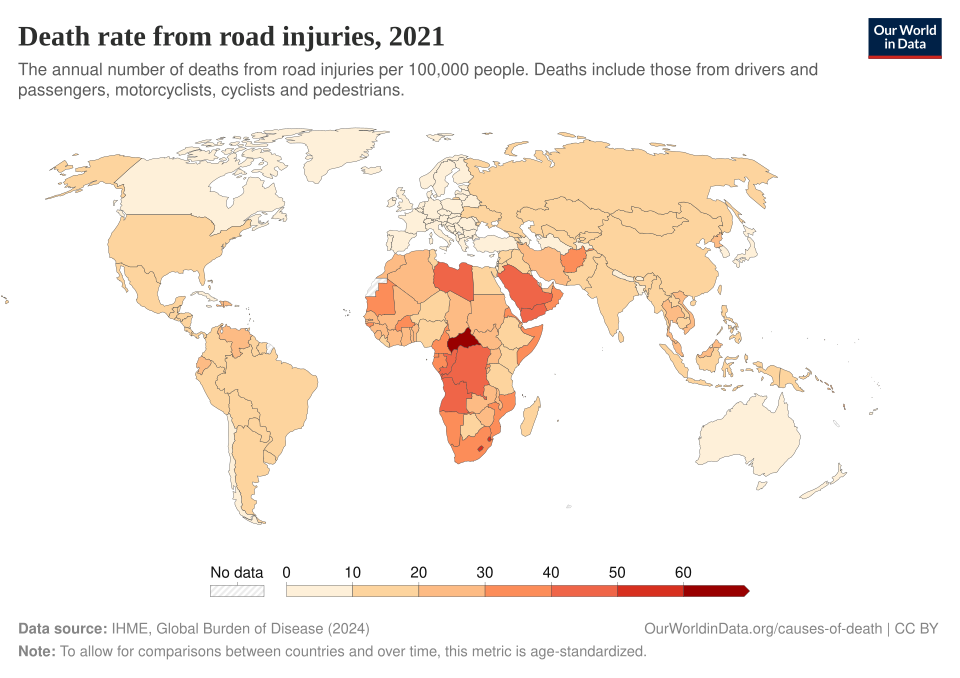
The same number of people die on the roads of the world every day as the number killed in the 9/11 World Trade Centre incident – 3200. Africa indeed has the highest fatality rate in the world, with most fatalities being pedestrians. These deaths are caused due to vehicle, road and human factors. Additionally, there exists serious human health and fitness issues.
Please press the play button below to listen to the audio narration. Once you are done, click “< Back to Social Risks” near the bottom of the page.
Transcript of audio
From an economic point of view, we have already seen that accident costs are real, not only in the damage to vehicles but also in travel time. However, accidents have the highest impact on human health. Fatalities and injuries. If we start unpacking fatalities, the same number of people die on the roads every day in the world as during 9/11. How much money do we spend on anti-terrorism compared to on-road safety? Africa is the continent with the highest road safety fatalities. Most fatalities in Africa are pedestrians. And if we look at pedestrians, drivers and passengers, we see that 20 to 25% of these fatalities are female, where males make up 75 to 80% of the fatalities. When analysing road fatalities, you have to keep in mind that vehicle, the road infrastructure and human factors cause these fatalities. Besides fatality issues, other human health issues are the fitness of people, how healthy they are. So we have already pointed to asthma, but there is also cardiovascular, diabetes, depression, dementia, breast cancer and colon cancer effects based on road traffic crashes.


This project has received funding from the European Union’s Horizon Europe research and innovation programme under grant agreement No 101069525. The sole responsibility for the content of this website lies with the authors. It does not necessarily reflect the opinion of the European Union. Neither the CINEA nor the European Commission are responsible for any use that may be made of the information contained therein.
© 2026 TransSafe Africa