
Risk Factors & Road Safety Issues Online Course
Introduction: A broader view of transport related risk

Transcript of audio
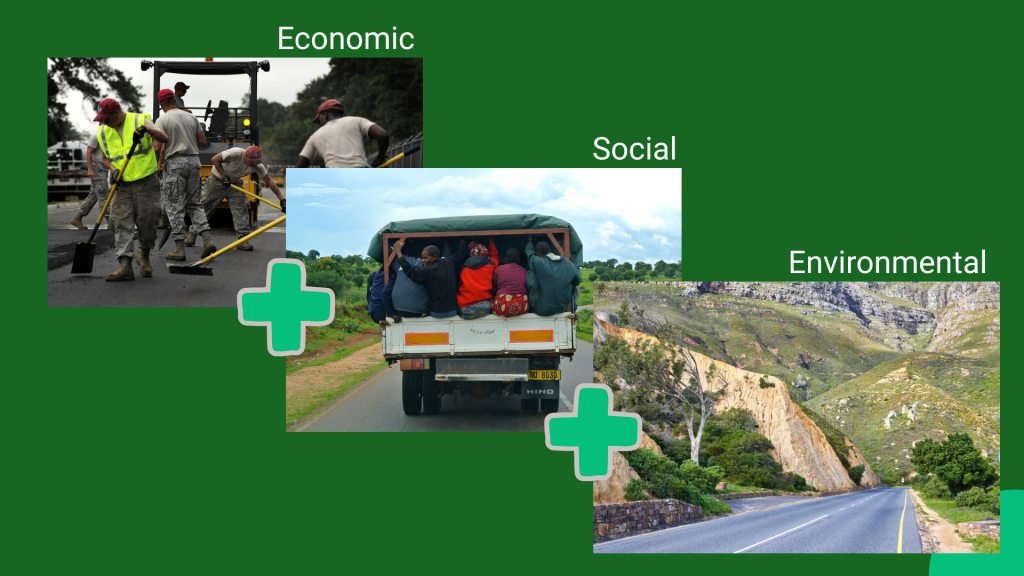
If we look at transport related risk, we can go to various sources and one of the sources that has elaborated upon transport related risks is Litman and Burwell. They have identified that traffic congestion, mobility barriers, accident damage, fatality costs, consumer costs, and depletion of non-renewable resources are the economic costs related to transport. Socially, inequity and the impact of that, mobility disadvantages, human health impacts, such as asthma created by pollution, community interaction or the lack thereof, and community liveability, as well as aesthetics are part of social. And environmentally, it’s air and water pollution, habitat loss, hydrological impacts, and again the depletion of non-renewable resources. However, if we think about the South African context, we can add to this and also over time we have added aspects to this. So, for example, socially the security risks related to transport, carjackings for example, or environmentally the loss of wildlife, noise and noise pollution and global warming have been identified. We now unpack these further.
As we analyse risk factors and road safety issues, it’s best not to think of them in narrow terms. Drawing on work published by Litman and Burwell (2006), we have a starting point for thinking about the broader complexities of risk and road safety, as summarised in this table:
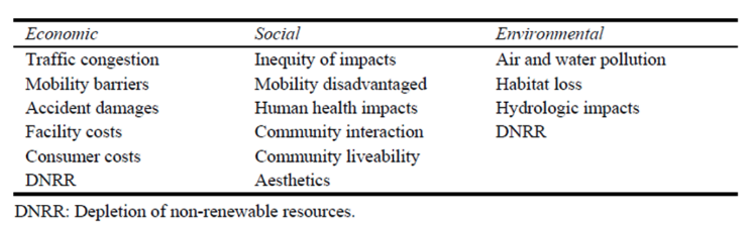
However, we would like to expand on this table by highlighting security risks under social risk, as well as wildlife loss, noise pollution and global warming under environmental factors. In the next few lessons, we will have a closer look at each of these risk factors, one by one.
< < Back to Transport Excellence Home Page



This project has received funding from the European Union’s Horizon Europe research and innovation programme under grant agreement No 101069525. The sole responsibility for the content of this website lies with the authors. It does not necessarily reflect the opinion of the European Union. Neither the CINEA nor the European Commission are responsible for any use that may be made of the information contained therein.
© 2026 TransSafe